


Tsunami of dirt: What caused Nepal's deadly glacial flood?
Published: August 27, 2026 3.56am BST
By Levan Tielidze
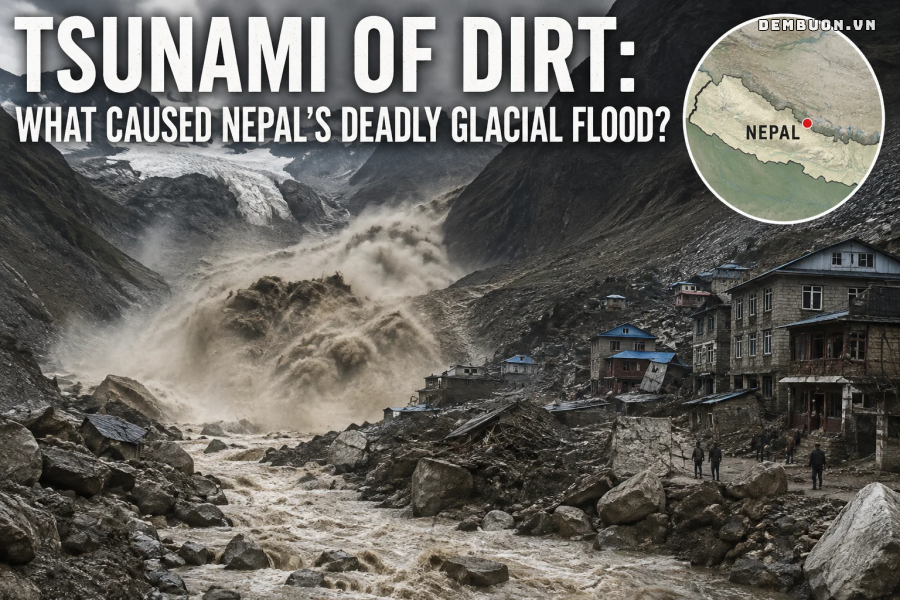
More than 150 people are dead and hundreds more missing after an enormous wave of water, ice, mud and rock cascaded more than 170 kilometres down the Bhote Koshi River valley in Nepal. The valley is the main link between Kathmandu in Nepal and Lhasa in Tibet. At least 34 Australians are missing. There was little warning.
Hơn 150 người đã thiệt mạng và hàng trăm người khác vẫn mất tích sau khi một dòng nước khổng lồ cuốn theo nước, băng, bùn và đá đổ xuống hơn 170 km dọc theo thung lũng sông Bhote Koshi ở Nepal. Thung lũng này là tuyến kết nối chính giữa Kathmandu ở Nepal và Lhasa ở Tây Tạng. Ít nhất 34 công dân Australia hiện vẫn đang mất tích. Hầu như không có cảnh báo trước.
Footage of the debris-laden flash flood is shocking. It is, unfortunately, not surprising.
Những hình ảnh về trận lũ quét cuồn cuộn mang theo đầy bùn đất và các mảnh vụn thật sự gây sốc. Đáng tiếc là, điều này không hoàn toàn bất ngờ.
As an expert in glaciers, I have tracked their accelerating retreat around the world as they melt – and the disasters that can follow. Early analysis suggests the abrupt collapse of a glacier triggered the disaster.
Là một chuyên gia về sông băng, tôi đã theo dõi tốc độ thu hẹp ngày càng nhanh của chúng trên khắp thế giới khi chúng tan – cũng như những thảm họa có thểxảy ra sau đó. Những phân tích ban đầu cho thấy sự sụp đổ đột ngột của một sông băng có thể đã châm ngòi cho thảm họa này.
As climate change intensifies, glaciers worldwide are melting – even in high regions such as the Himalayas. The Himalayas are especially vulnerable, because the steep slopes of many of these very tall mountains are made of permafrost – rock and soil frozen for centuries. As temperatures rise, these slopes are beginning to melt or destabilise. If an earthquake or slope failure occurs, it can trigger a sudden and devastating debris flow.
Khi biến đổi khí hậu ngàycàng nghiêm trọng, các sông băng trên toàn thế giới đang tan chảy – ngay cả tại những khu vực có độ cao lớn như dãy Himalaya. Himalaya đặc biệt dễ bị tổn thương bởi độ dốc lớn của nhiều ngọn núi cao tại đây được cấu tạo từ tầng đất đóng băng vĩnh cửu (permafrost) – lớp đá và đất đã bị đóng băng trong suốt hàng thế kỷ. Khi nhiệt độ tăng lên, những sườn núi này bắt đầu tan chảy hoặc trởnên mất ổn định. Nếu xảy ra động đất hoặc hiện tượng sạt lở sườn núi, nó có thể kích hoạt một dòng chảy bùn đá đột ngột và có sức tàn phá khủng khiếp.
It's too early to say this was the exact cause. But we know that the great ice stores of the Himalayas – known as the world's"third pole" because it contains the largest amount of snow and ice after the Arctic and Antarctic – areno longer safe.
Hiện vẫn còn quá sớm để khẳng định đây chính xác là nguyên nhân gây ra thảm họa. Tuy nhiên, chúng ta biết rằng những kho băng khổng lồ của Himalaya – được gọi là "cực thứ ba" của thế giới vì nơi đây chứa lượng tuyết và băng lớn nhất sau Bắc Cực và Nam Cực – không còn an toàn nữa.
Từ vựng
1. Enormous /ɪˈnɔːməs/: Adjective. Khổng lồ, cực kỳ lớn.
Extremely large in size or amount.
Example: The disaster caused enormous damage.
2. Cascade /kæˈskeɪd/: Verb. Cuồn cuộn đổ xuống, chảy ào xuống.
To flow or fall rapidly and in large amounts.
Example: Water cascaded down the mountain after the heavy rain.
3. Main link /meɪn lɪŋk/: Noun phrase. Tuyến kết nối chính.
An important route or connection between two places.
Example: The highway is the main link between the two cities.
4. Little warning /ˈlɪtl ˈwɔːnɪŋ/: Noun phrase. Hầu như không có cảnh báo trước.
Very little advance notice before something happens.
Example: The earthquake struck with little warning.
5. Footage /ˈfʊtɪdʒ/: Noun. Đoạn phim, hình ảnh ghi lại.
Recorded video material showing an event.
Example: Footage of the disaster was broadcast worldwide.
6. Debris-laden /ˈdebriː ˌleɪdən/: Adjective. Chứa đầy/cuốn theo mảnh vụn.
Containing or carrying a large amount of debris.
Example: A debris-laden flood swept through the village.
7. Flash flood /ˈflæʃ flʌd/: Noun. Lũ quét.
A sudden flood that happens very quickly.
Example: Heavy rainfall triggered a flash flood.
8. Expert in /ˈekspɜːt ɪn/: Noun phrase. Chuyên gia về.
A person with a high level of knowledge or skill in a particular subject.
Example: She is an expert in environmental science.
9. Track /træk/: Verb. Theo dõi.
To carefully observe or monitor something over time.
Example: Scientists track changes in global temperatures.
10. Accelerating retreat /əkˈseləreɪtɪŋ rɪˈtriːt/: Noun phrase. Sự thu hẹp ngày càng nhanh.
A process in which something is becoming smaller or receding at an increasing rate.
Example: Scientists are concerned about the accelerating retreat of glaciers.
11. Around the world /əˈraʊnd ðə wɜːld/: Adverbial phrase. Trên khắp thế giới.
In many different parts of the world.
Example: Glaciers are melting around the world.
12. Follow /ˈfɒləʊ/: Verb. Xảy ra sau, tiếp theo.
To happen after something else.
Example: Severe flooding can follow prolonged rainfall.
13. Early analysis /ˈɜːli əˈnæləsɪs/: Noun phrase. Những phân tích ban đầu.
An initial examination of information or evidence.
Example: Early analysis suggests that the damage was extensive.
14. Suggest /səˈdʒest/: Verb. Cho thấy, chỉ ra.
To indicate that something is probably true.
Example: The evidence suggests that temperatures are rising.
15. Abrupt /əˈbrʌpt/: Adjective. Đột ngột.
Sudden and unexpected.
Example: There was an abrupt change in temperature.
16. Collapse / kəˈlæps/: Noun. Sự sụp đổ.
Example: The abrupt collapse of the glacier caused a massive flood.
17. Trigger the disaster /ˈtrɪɡə (r) ðə dɪˈzɑːstə (r) /: Verb phrase. Gây ra thảm họa.
To cause a disaster to happen.
Example: The collapse may have triggered the disaster.
18. Intensify /ɪnˈtensɪfaɪ/: Verb. Trở nên mạnh/nghiêm trọng hơn.
To become
Stronger or more severe.
Example: Extreme weather events may intensify as temperatures rise.
19. Especially vulnerable /ɪˈspeʃəli ˈvʌlnərəbl/: Adjective phrase. Đặc biệt dễ bị tổn thương.
Particularly likely to be harmed or affected.
Example: Coastal communities are especially vulnerable to flooding.
20. Steep slope /stiːp sləʊp/: Noun phrase. Sườn dốc, sườn núi dốc.
A slope that rises or falls at a sharp angle.
Example: Heavy rain can make a steep slope unstable.
21. Permafrost /ˈpɜːməfrɒst/: Noun. Tầng đất đóng băng vĩnh cửu.
A layer of soil or rock that remains frozen for a very long period.
Example: Rising temperatures are causing permafrost to melt.
22. Destabilise /diːˈsteɪbəlaɪz/: Verb. Làm/trở nên mất ổn định.
To make something less stable or more likely to collapse.
Example: Melting permafrost can destabilise mountain slopes.
23. Slope failure /sləʊp ˈfeɪljə (r) /: Noun phrase. Sự sạt lở/sụp đổ sườn dốc.
The collapse or downward movement of material on a slope.
Example: Heavy rainfall can cause slope failure.
24. Occur /əˈkɜː (r) /: Verb. Xảy ra.
To happen, especially unexpectedly.
Example: Earthquakes can occur without warning.
25. Devastating /ˈdevəsteɪtɪŋ/: Adjective. Có sức tàn phá khủng khiếp.
Causing very serious damage or destruction.
Example: The earthquake had a devastating impact on the region.
26. Debris flow /ˈdebriː fləʊ/: Noun phrase. Dòng chảy mảnh vụn/đất đá.
A rapidly moving mixture of water, mud, rocks, and other debris.
Example: The earthquake triggered a massive debris flow.
27. Too early to say /tuː ˈɜːli tə seɪ/: Fixed expression. Còn quá sớm để nói/kết luận.
Used when there is not enough information to make a definite conclusion.
Example: It is too early to say whether the policy will succeed.
28. Ice stores /aɪs stɔːz/: Noun phrase. Trữ lượng băng.
Large quantities of ice stored naturally in a particular region.
Example: The Himalayas contain enormous ice stores.
29. Be known as /biː nəʊn æz/: Verb phrase. Được biết đến/gọi là.
To be commonly called or referred to by a particular name.
Example: The region is known as the "third pole".
30. The third pole /ðə θɜːd pəʊl/: Noun phrase. "Cực thứ ba".
A term for a region containing an exceptionally large amount of snow and ice outside the Arctic and Antarctic.
Example: The Himalayas are often described as the third pole.
31. No longer /nəʊ ˈlɒŋɡə (r) /: Adverb. Không còn.. Nữa.
Not anymore.
Example: Some areas are no longer suitable for farming.
Còn tiếp..